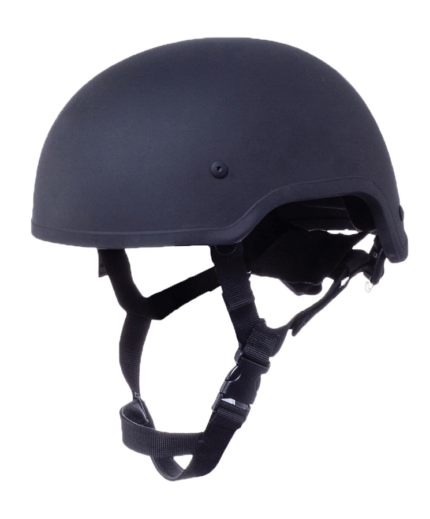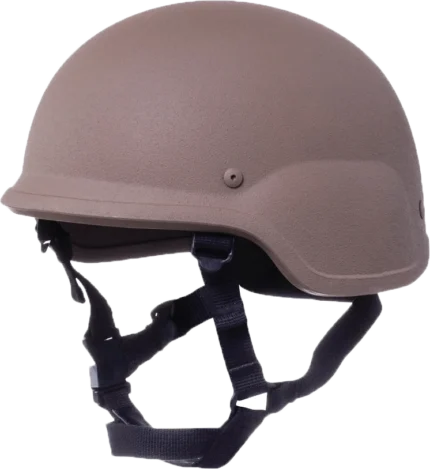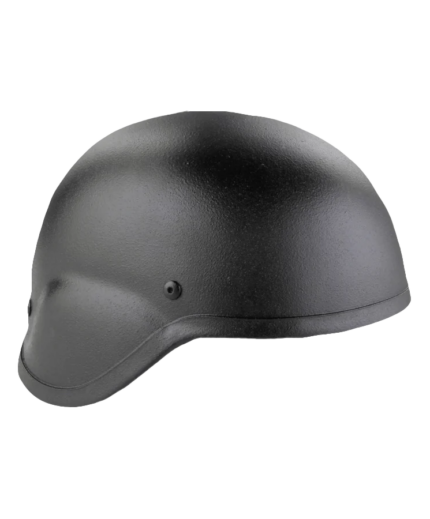


PASGT stands for Personnel Armor System for Ground Troops, the U.S. military’s Kevlar helmet fielded in 1983 to replace the steel M1 “pot.” It stops fragmentation, and it’s still issued by allied forces, corrections agencies and training units.
If you’re staring at a surplus listing or a department quote sheet trying to figure out what size to order, what the shell markings mean, or whether a PASGT is even the right helmet for the job anymore, this guide covers all of it: sizing, weight, ballistic rating, accessories, and where it still makes sense next to a modern high-cut.
A Short History of the PASGT Helmet
The PASGT program replaced two very different pieces of gear at once: the M1 steel helmet that had protected American troops since World War II, and the older nylon flak vest. The Army adopted the PASGT helmet in 1983, and by 1985 it was standard issue across the force. Built from stacked layers of Kevlar aramid fabric instead of stamped steel, it was lighter than the M1 in some configurations, offered better fragmentation coverage, and didn’t ring like a bell when it took a hit.
By the early 2010s, the Army and Marine Corps had largely moved to lower-profile designs — the Modular Integrated Communications Helmet (MICH) and its successor, the Advanced Combat Helmet (ACH) — that cut away material around the ears for better hearing and radio-headset fit. That transition is worth its own read; we cover it in our full ballistic helmet buyer’s guide. But PASGT didn’t disappear. Its high production numbers, low unit cost, and simple maintenance kept it in service with the U.S. Navy, dozens of allied militaries, and — closer to home — corrections departments, training academies, and agencies that need reliable head protection without a high-cut helmet’s price tag.
PASGT Helmet Sizing: The Real Size Chart
Sizing is the single most common question we get on PASGT, and it’s also the thing most retailers get wrong by copy-pasting a vague “one size fits most” line. It doesn’t. PASGT shells were manufactured by several contractors (Gentex, ArmorSource, MSA and others) under the same military specification, so exact breakpoints shift a little from one production run to the next. The chart below reflects the standard GI contract spread you’ll see across most shells on the market today — use it to get in the right range, then confirm fit against the manufacturer’s own card if one is included.
| Size | Head Circumference (in) | Head Circumference (cm) |
|---|---|---|
| X-Small (XS) | 19.5 – 20.5″ | 49.5 – 52 cm |
| Small (S) | 20.5 – 21.5″ | 52 – 54.5 cm |
| Medium (M) | 21.5 – 22.5″ | 54.5 – 57 cm |
| Large (L) | 22.5 – 23.5″ | 57 – 59.5 cm |
| X-Large (XL) | 23.5 – 24.5″ | 59.5 – 62 cm |
Most adult buyers land in Medium or Large. If your measurement falls right on a breakpoint, size up rather than down — the suspension and nape strap take up the slack on a slightly large shell, but a shell that’s genuinely too small won’t seat correctly no matter how you adjust the webbing, and that’s a real coverage problem, not just a comfort one.
Reading the Shell Markings
Every GI-spec PASGT shell has its size and production data stamped or stenciled on the inside, usually on the crown or just above the nape band. At minimum you should be able to find the size letter (XS/S/M/L/XL) stamped into or printed on the shell, along with the manufacturer’s name or code, a lot/contract number, and a date of manufacture. Some shells also carry an NSN (National Stock Number) sticker or stamp. If a listing doesn’t show you a clear photo of this interior marking, ask for one before you buy — it’s the fastest way to confirm size and to get a rough sense of the helmet’s age and prior use.
Shopping for a current-production shell instead of surplus? Our PASGT ballistic helmet page has size availability and spec sheets for each shell size, so you can match a size to your measurement without guessing from a decades-old GI chart.
How to Measure Your Head Correctly
Wrap a soft measuring tape (or a length of string you then measure against a ruler) around your head about one inch above your eyebrows and ears, keeping it level all the way around — this is the widest part of most people’s skull and the line the PASGT sizing above is built around. Pull it snug but not tight, take the reading, and if you’re between two sizes on the chart above, round up. Measure twice; a quarter-inch error at the tape is the difference between a comfortable fit and a helmet that rides too high or presses on the temples after an hour on shift.
Weight by Size — and How It Compares to a Modern High-Cut
Weight scales with shell size, since a bigger shell means more layers of material to cover more surface area.
| Size | Approx. Weight (lb) | Approx. Weight (kg) |
|---|---|---|
| X-Small | 3.1 lb | 1.41 kg |
| Small | ~3.3 lb | ~1.5 kg |
| Medium | ~3.6 lb | ~1.65 kg |
| Large | ~3.9 lb | ~1.8 kg |
| X-Large | 4.2 lb | 1.91 kg |
For reference, a modern high-cut helmet like the MICH/ACH comes in lighter for a comparable head size — roughly 3 lb (1.36 kg) in a Medium and around 3.6 lb (1.63 kg) at the largest sizes, before you add rails, mounts or a counterweight on the back to balance a night-vision setup. In practice, that means a Medium PASGT and a Medium high-cut sit within a few ounces of each other, but the gap widens at the larger sizes, and it compounds fast once you’re wearing a helmet for a 10- or 12-hour shift. Weight isn’t just a spec on a page — it’s neck fatigue at hour eight.

Ballistic Rating: What a PASGT Shell Actually Stops
PASGT was built as fragmentation protection first. The Kevlar shell is rated to defeat fast-moving shrapnel and debris from artillery, mortars, grenades and IEDs — the threats a soldier in a blast environment is statistically most likely to face — and testing describes that capability in terms of V50, the velocity at which half of a given fragment simulant is stopped and half penetrates. A higher V50 against a given fragment weight means better fragmentation performance.
Handgun protection is a separate question, and it’s where PASGT is most often oversold. Shells built to the original mil-spec are generally referenced against a Threat Level IIIA-equivalent standard, which in modern NIJ terms covers most handgun rounds including .44 Magnum — but “equivalent” is doing real work in that sentence. Certification standards, test protocols and shell construction have all moved on since the 1980s, and a decades-old surplus shell has no guarantee of retaining its as-manufactured performance. If your use case involves credible handgun threats — corrections intake, courtroom security, an active-shooter response role — you need a helmet currently certified to NIJ 0101.06 or 0101.07, tested and dated, not a shell whose ballistic history you’re taking on faith. We break down what those NIJ levels actually mean, and how testing works, in our guide to decoding NIJ ratings.
The honest summary: PASGT is a solid fragmentation helmet with a IIIA-equivalent handgun pedigree on paper. Treat “on paper” as the operative phrase for anything beyond fragmentation, and buy new or currently-certified shells whenever handgun threats are part of the actual job.
PASGT Accessories
Part of what’s kept PASGT viable for four decades is how much gear was built around it:
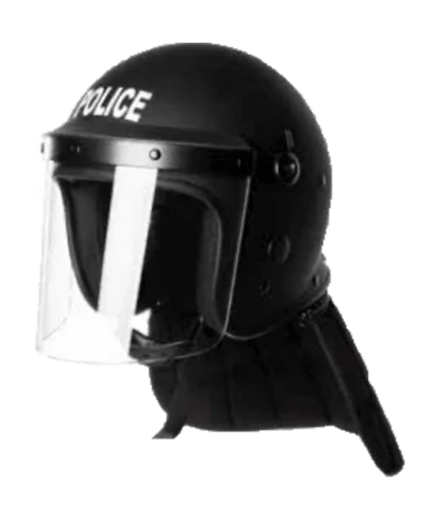
- Visors and face shields — polycarbonate riot visors and full face shields mount to the front of the shell for crowd-control and correctional applications, adding eye and lower-face protection without swapping the helmet.
- Covers — woodland, three-color and six-color desert, UCP/MultiCam, solid olive drab, and law-enforcement-specific covers all fit the same shell pattern, letting one helmet serve multiple environments or agency uniform standards.
- Retention systems — the original sling suspension has largely been superseded by four-point or H-nape retention systems and modern pad kits, which do more for stability and comfort than any other single upgrade you can make to an older shell.
- Mounts — NVG shrouds and rail adapters exist for PASGT, though they’re less common and less integrated than on a purpose-built high-cut shell.
PASGT vs. Modern Ballistic Helmets
The honest answer is that “better” depends entirely on what you’re buying it for.
PASGT still makes sense when: you’re outfitting on a fixed per-unit budget across a large roster (corrections, training academies, static security posts); the role is crowd control, riot response, or perimeter duty rather than dynamic entry; hearing and radio-headset compatibility aren’t priorities; or you need a helmet that’s simple to maintain and replace at scale rather than one built for NVG counterweight and rail-mounted accessories.
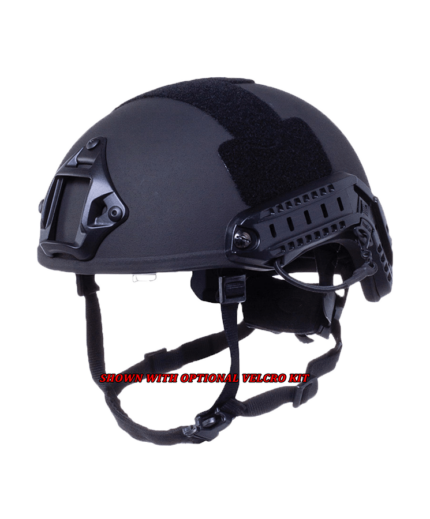
A modern high-cut is the right call when: the role involves long gun engagement or shooting-position cheek weld (PASGT’s ear coverage gets in the way); the team runs night vision, comms headsets, or rail-mounted lights and needs the cutaway profile; individual weight and hot-weather fatigue over a long shift are operational concerns, not just comfort ones; or the certification requirement calls for current NIJ 0101.06/0101.07 testing rather than a legacy IIIA-equivalent rating. Our Tank ballistic helmet is the modern high-cut most departments compare against PASGT when they’re deciding whether to make the switch.
Plenty of agencies run both: PASGT for training, corrections and static roles, and a high-cut for tactical teams. That split gets more out of a fixed equipment budget than standardizing on one helmet for every assignment.
Where to Buy a PASGT Helmet
U.S. Armor’s PASGT ballistic helmet is built to current standards with a documented ballistic pedigree — not a decades-old shell of unknown history — and it’s available across the full XS–XL size range covered above. Browse the complete lineup in our ballistic helmet category, or if you’re outfitting a department or agency and want help matching sizes, certification level and accessories to your specific roster, find a U.S. Armor dealer near you.
Explore Our Most Popular Helmets