Knowing how to choose a ballistic shield starts with one honest question: what mission will this shield serve, and what threat will it face? A handheld Level IIIA shield in a patrol trunk, a rifle rated ballistic shield on the tactical team and a full-coverage shield for a corrections response team are three different tools. Each one trades protection against weight, size and speed. This guide from U.S. Armor Corporation walks SWAT commanders, patrol supervisors, training officers and procurement teams through eight critical factors, explains what NIJ does and does not certify, and ends with a vendor checklist you can take straight into your next purchasing meeting.
Picture a SWAT team lead who must recommend one shield for every patrol car and a heavier option for the entry team, all inside a fixed budget. Learning how to choose a ballistic shield for both roles is exactly what this guide supports.
What Is a Ballistic Shield and Who Needs One?
A ballistic shield is a portable, hand-carried barrier made of composite ballistic materials that protects the officer carrying it and, often, the officers stacked behind. Unlike body armor, it can be moved between the threat and the team and covers the head and legs as well as the torso.
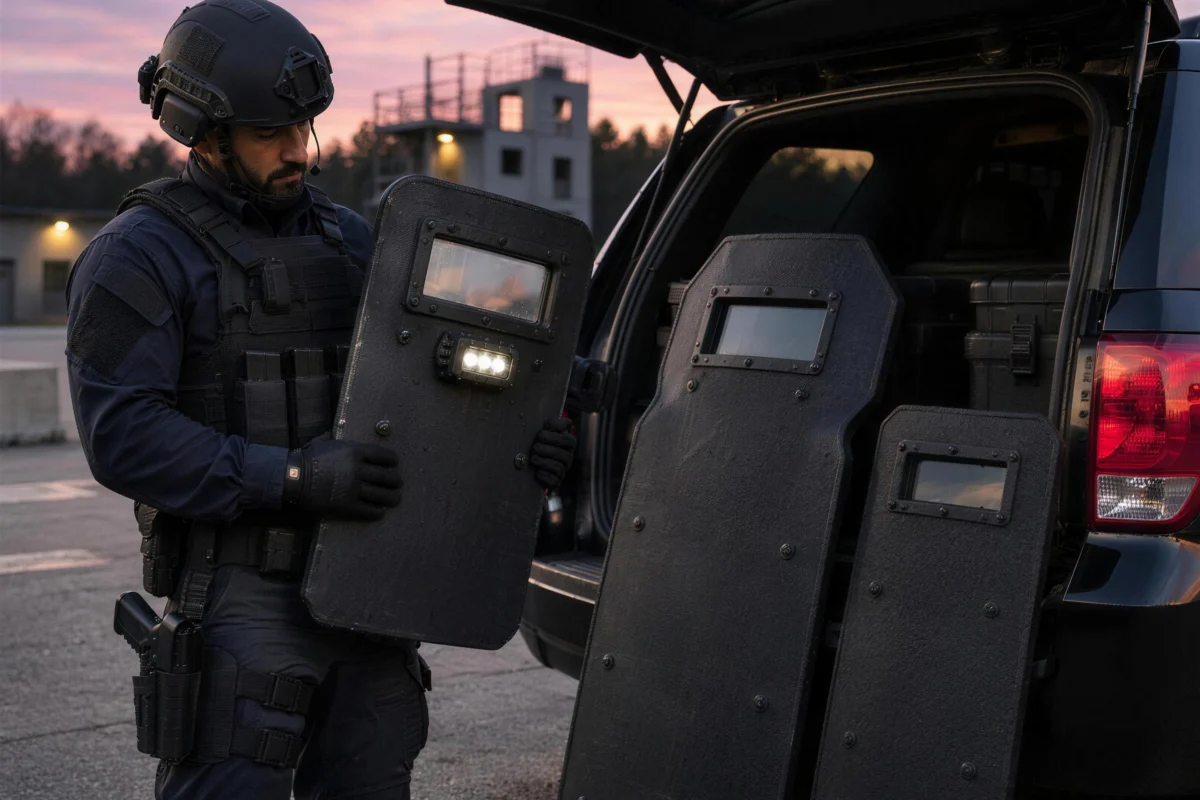
Shields have moved well beyond the SWAT truck, which is why so many supervisors now ask how to choose a ballistic shield for patrol. Many agencies now stage a police ballistic shield in patrol vehicles so the first officers on scene at an active threat can move toward the danger with cover. Campus police, corrections teams and executive protection details use them too, but rarely need the same one.
How to Choose a Ballistic Shield: Start With the Mission
Before you compare spec sheets, define the job. The simplest way to decide how to choose a ballistic shield is to match each mission to a protection level, a size and a realistic carry weight, using the matrix below.
| Mission | Typical protection level | Typical size | Weight priority | Key features |
|---|---|---|---|---|
| Patrol rapid response | Level IIIA (handgun) | 18″×30″ to 20″×34″ | Lightest practical; one-officer deployment | Fits the trunk, quick-grab handle, shield light |
| Tactical entry / SWAT | Level IIIA for speed, Level III or III+ for rifle threats | 20″×34″ to 24″×36″ | Balanced against threat; team rotation | Viewport, weapon mount, high-output light |
| Corrections / cell extraction | Level IIIA, often stab-rated | 24″×36″ or larger | Coverage over speed | Full coverage, edge protection, sturdy straps |
| School and campus police | Level IIIA, rifle option for team leads | 20″×34″ | Light enough for solo officers | Viewport, shield light, simple handle |
| Executive protection | Level IIIA | Compact or folding | Discreet carry | Fast deployment, low profile |
A downloadable version of this mission matrix, paired with the vendor checklist later in this article, is available as a free PDF: download the Ballistic Shield Selection Matrix (PDF).
Factor 1: Match the Protection Level to the Threat
The first decision when working out how to choose a ballistic shield is the threat level. Every step up in protection adds weight, and weight is the enemy of speed. Choose the lowest level that defeats the threats your officers realistically face.
Level IIIA Ballistic Shield: The Standard Police Ballistic Shield
A level IIIA ballistic shield is rated to stop common handgun threats, including high-velocity 9mm and .44 Magnum rounds under NIJ 0108.01 test conditions. It is the most common police ballistic shield because it offers the best balance of weight, size and cost for patrol, corrections and most entry work. Many are also special threats tested, so read the tested-threat list, not just the level.
Rifle Rated Ballistic Shield for Entry and High-Risk Warrants
A rifle rated ballistic shield is built for teams that expect long-gun threats. Level III protection addresses 7.62×51mm M80 ball, and “III+” is a manufacturer special-threat designation that typically adds common rounds such as 5.56×45mm M193 and 7.62×39mm mild steel core. When comparing level IIIA vs level III ballistic shield options, the honest answer is that most agencies need both: IIIA for speed and availability, rifle-rated for planned high-risk operations.
Factor 2: Understand What NIJ Does and Does Not Certify
This is where many buyers get caught out. The National Institute of Justice Compliance Testing Program tests and certifies body armor, and NIJ notes that, apart from body armor, it has never tested or certified other ballistic items. Ballistic shields are not on the NIJ Compliant Products List. A shield described as “NIJ certified” is a red flag.
What reputable manufacturers do instead is have shields tested by an independent, accredited laboratory to the protection levels defined in NIJ 0108.01, the 1985 standard for ballistic resistant protective materials. The correct language is “tested to” or “rated to” NIJ 0108.01. Ask for the lab reports, not just a sticker.
Terminology is also changing. NIJ Standard 0123.00 replaces the familiar levels with new names: HG1 and HG2 for handgun protection (replacing Level II and IIIA) and RF1, RF2 and RF3 for rifle protection (RF1 replaces Level III, RF2 is a new intermediate level and RF3 replaces Level IV). NIJ expects future revisions of its standards for helmets and shields to reference 0123.00, so shield buyers in 2026 and 2027 will see both naming systems. Ask vendors how their ratings map to the new levels.

Factor 3: Size and Coverage Area
Size is the next step in how to choose a ballistic shield, because size drives coverage and coverage drives weight. Common handheld sizes run from roughly 18″×30″ to 24″×36″. A larger shield protects more and shelters a second officer, but is harder to move through doorways and stairwells.
- 18″×30″: fastest and lightest; covers the head and torso of most officers in a crouch. Good for solo patrol deployment.
- 20″×34″: the most common middle ground for patrol and campus teams.
- 24″×36″: more leg coverage; favored by corrections teams and entry teams that move slowly and deliberately.
Also check the shape: a full cut adds corner coverage, while a weapon-mount edge improves firing positions on rifle shields.
Factor 4: Ballistic Shield Weight and Maneuverability
Ballistic shield weight is the factor officers feel first, and it often decides how to choose a ballistic shield between two good options. For reference, U.S. Armor Corporation’s Level IIIA shields weigh between 11 and 15 lbs across the 18″×30″ to 24″×36″ sizes, as shown in the comparison table below.
Rifle shields are noticeably heavier at the same size, so ask for the exact weight at the size you plan to buy, including the light and any mount. Then have your own officers hold a ready position, move through a doorway and fire from behind it. A shield too heavy to deploy quickly stays in the trunk.
Factor 5: Viewport and Visibility
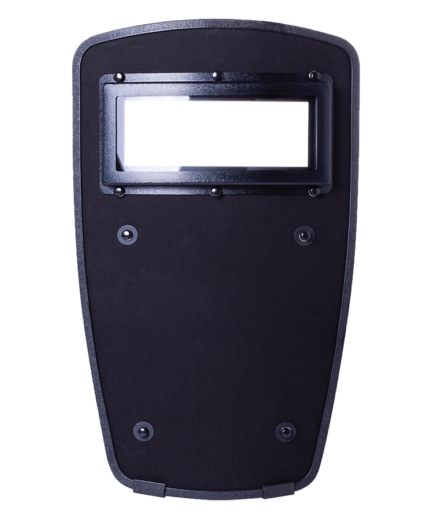
Visibility is easy to overlook when learning how to choose a ballistic shield. A ballistic viewport lets the officer see without exposing the head. The tradeoff is weight and, on some designs, a slightly lower rating at the window. U.S. Armor Corporation offers a 5″×11″ viewport with a viewport-delete option for agencies that prefer a solid face, as well as a patented wide-field viewport designed for extreme close quarters.
Ask whether the viewport is tested to the same threats as the panel, how it handles fogging and scratches, and whether it is replaceable.
Factor 6: Handles, Lights and Weapon Mounts
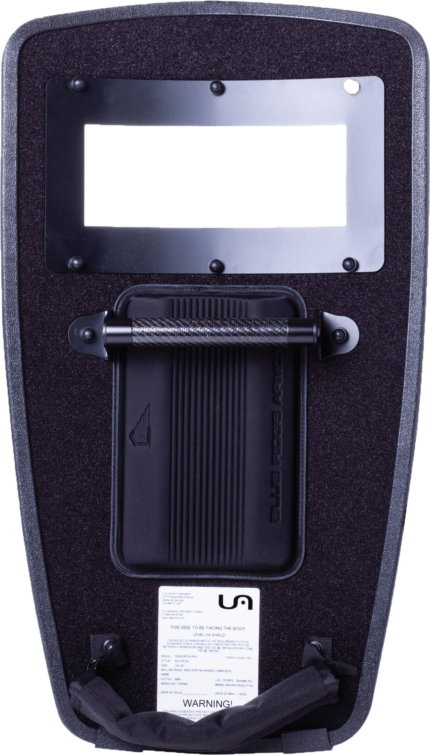
Accessories decide whether a shield works in the real world, so treat them as part of how to choose a ballistic shield, not an afterthought. Look for an ambidextrous handle, a padded forearm strap and a shield light that can be activated from either hand. The B30 Shield Light delivers 600 lumens with strobe capability, and the B70 Shield Light adds dual power and mode switches for either-hand control. Elzetta light and handle options let teams standardize grip and lighting.
For rifle shields, a weapon mount and a flat panel edge improve stability and speed to sight acquisition. Make sure accessories are retrofittable.

Factor 7: Patrol Vehicle Deployment and Ballistic Shield Training
A shield in the trunk only helps if officers can reach it and use it under stress. Before placing a shield in every patrol car, confirm it fits alongside other gear, can be grabbed in seconds and has a carry bag that protects it from heat and abrasion.
Ballistic shield training is not optional. Officers need to practice one-officer and two-officer movement, shooting from behind the shield, transitions and handoffs, and moving with a team in a hallway. Build shield drills into active-threat training at least annually, and more often for tactical teams. U.S. Armor Corporation’s guide to active shooter body armor covers how shields and armor work together in these scenarios.
Factor 8: Budget, Funding and Lifecycle
Price matters when you decide how to choose a ballistic shield, but cost per year of service matters more. Ask about the warranty, recommended service life, inspection guidance and the cost of replacement parts such as straps, pads and viewports.
Funding is the other half of the equation. Shields are generally not covered by the Bulletproof Vest Partnership, which is limited to body armor, so agencies often turn to other federal, state or local grant programs and capital budgets. U.S. Armor Corporation’s grants and budget guide outlines ballistic shield grant funding options and how to build a justification that procurement officers will approve.
How to Choose a Ballistic Shield: Questions to Ask Your Vendor
This checklist is the practical end point of how to choose a ballistic shield. Use it to keep every vendor conversation on the same footing; if a vendor cannot answer in writing, treat that as an answer.
- Which independent, accredited laboratory tested this shield, and can you provide the full test reports?
- Which standard and protection level was it tested to (for example, NIJ 0108.01 Level IIIA or III)?
- What is the complete list of special threats tested, with bullet weights and velocities?
- Is the viewport tested to the same threats as the panel?
- How will your ratings map to the NIJ 0123.00 HG and RF levels?
- What is the exact weight at the size we are buying, with the light and mounts installed?
- Is the handle ambidextrous, and can lights and mounts be retrofitted later?
- What is the warranty, the recommended service life and the inspection guidance?
- Are replacement straps, pads and viewports available, and at what cost?
- Can you provide a demonstration or loaner so our officers can train with it before we buy?
Never accept “NIJ certified” as an answer for a shield. The right answer is a lab report.
Compare U.S. Armor Corporation Ballistic Shields
Once you know how to choose a ballistic shield for each mission, here is how U.S. Armor Corporation’s shield line maps to the missions above. Full specifications are on each product page and in the ballistic shields category.
| Shield | Rating | Sizes and weight | Viewport | Best fit |
|---|---|---|---|---|
| Equalizer Level IIIA Shield | Level IIIA, handgun and special threats tested | 18″×30″ / 12 lbs; 20″×34″ / 13.5 lbs; 24″×36″ / 15 lbs | 5″×11″ (delete option) | Patrol rapid response, campus police, corrections |
| Vengeance WMX2 Level IIIA Shield | NIJ 0108.01 rated IIIA, special threats tested | 18″×30″ / 11 lbs; 20″×34″ / 13 lbs; 24″×36″ / 15 lbs | Patented VENGEANCE™ viewport | Tactical entry, team leads, full-cut coverage |
| Vengeance Level III+ Rifle Shield | NIJ 0108.01 rated III, special threat III+ | See spec sheet | Optional | SWAT and high-risk warrants facing rifle threats |
Ready to compare shields side by side? Review the Equalizer IIIA, Vengeance WMX2 IIIA and Vengeance Level III+ shields, or request a demonstration or quote from U.S. Armor Corporation’s team. For body armor that pairs with your shield program, see the law enforcement body armor guide and how to decode NIJ ratings.